
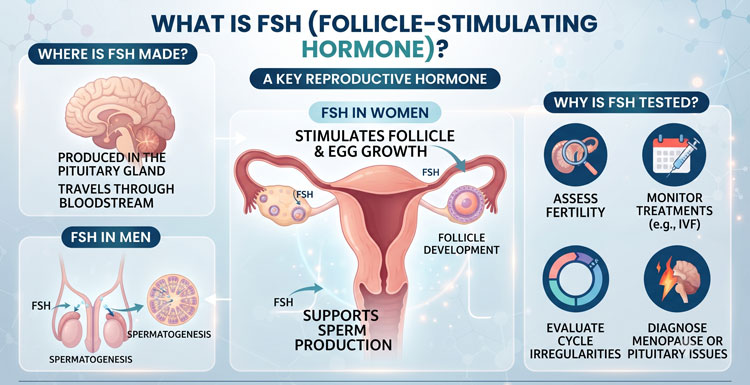
Follicle-stimulating hormone, or FSH, is one of the hormones your doctor is most likely to check first when you start asking questions about fertility. It’s a simple blood test, but the number it produces can carry a lot of weight in a conversation about your reproductive health — which makes it worth understanding what FSH actually is, not just what your result says.
What Is Follicle-Stimulating Hormone?
FSH is a hormone produced by the pituitary gland, a small gland at the base of the brain that acts as a control center for much of the body’s hormone activity. FSH belongs to a category of hormones called gonadotropins — hormones that act specifically on the gonads, meaning the ovaries in women and the testes in men.
As part of the endocrine system, FSH doesn’t work alone. Its production is regulated by a feedback loop involving the hypothalamus, the pituitary gland, and the ovaries or testes, all communicating through hormone signals to keep the reproductive cycle running on schedule.
What Does FSH Actually Do?
In women, FSH’s main job is to stimulate the growth of ovarian follicles — the small fluid-filled sacs in the ovaries, each containing an immature egg. Early in the menstrual cycle, rising FSH signals a group of follicles to begin developing. Typically, one follicle becomes dominant and eventually releases a mature egg during ovulation. Without adequate FSH, this process doesn’t get started, and ovulation doesn’t occur.
In men, FSH plays a related but different role: it supports the testes in producing sperm, working alongside luteinizing hormone (LH) and testosterone to maintain healthy sperm production.
What Counts as a Normal FSH Level?
FSH is measured in mIU/mL, and what’s considered “normal” depends heavily on age, sex, and where you are in your cycle. As general reference points:
- Adult men: roughly 1.5–12.4 mIU/mL
- Women of reproductive age (typically tested on day 2–3 of the cycle): roughly 4.7–21.5 mIU/mL
- Women after menopause: roughly 25.8–134.8 mIU/mL
Reference ranges vary somewhat from lab to lab, so it’s important to interpret your specific result with your doctor rather than comparing it against a chart alone.
What a High or Low FSH Result Can Mean
For women trying to conceive, FSH is most useful as a window into ovarian reserve — a general indicator of egg quantity and, to some degree, quality. Generally speaking, a lower FSH result within the expected range is a good sign for ovarian function. An elevated FSH level, particularly when tested early in the cycle, often points to diminished ovarian reserve: the ovaries are working harder — producing more FSH — to try to recruit and mature a follicle.
A high FSH result isn’t a diagnosis on its own, and it isn’t the end of the conversation about your fertility options. It’s one data point your care team weighs alongside other markers, such as anti-Müllerian hormone (AMH) and antral follicle count, along with your age and health history, to build a complete picture.
What Comes Next if Your FSH Is Elevated
An elevated FSH level understandably raises questions, but it doesn’t automatically rule out pregnancy — with or without treatment. Depending on your specific levels, age, and overall fertility picture, your options may include:
- In vitro fertilization (IVF), which allows for controlled ovarian stimulation and can still be effective even with a reduced egg supply
- Fertility medications to help stimulate follicle development
- Intrauterine insemination (IUI) paired with ovarian stimulation, in certain cases
- Egg donation, when ovarian reserve is significantly diminished
This is also where a treatment approach built specifically around ovarian health can matter. At Gen 5 Fertility, our ovarian rejuvenation program was designed for exactly this situation — for patients who’ve been told their FSH is high, their AMH is low, or their ovarian reserve is diminished, and who want to understand every option before moving to donor eggs.
If your FSH result has left you with more questions than answers, that’s exactly the conversation Dr. Samuel Wood and the team at Gen 5 Fertility are here to have with you. Book an appointment online or call our San Diego office to talk through what your levels mean for your specific path forward.
Sources Used for the Figures Above
For internal fact-checking reference — not necessarily meant to all be linked in the published post.
- FSH definition, function, and reference ranges: Cleveland Clinic; MedicalNewsToday; Medscape clinical reference
- High FSH, ovarian reserve, and IVF outcome data: RMA Network; peer-reviewed IVF outcome studies on diminished ovarian reserve